
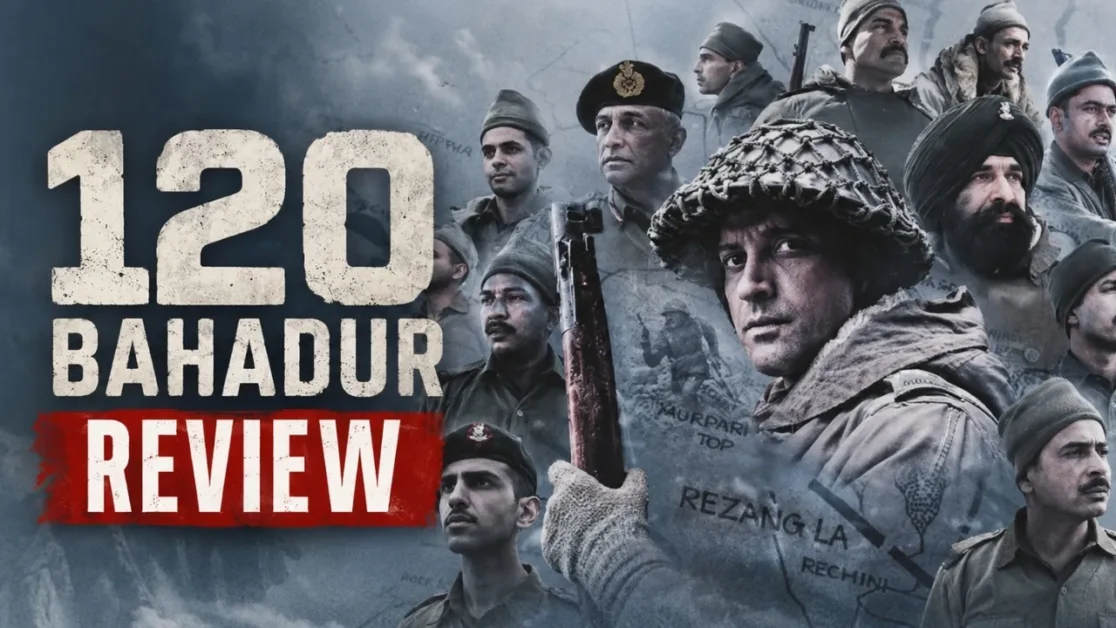
 by
by Some war films are designed like adrenaline machines. They move quickly, keep emotions broad, and make sure every sacrifice lands in the safest possible way. 120 Bahadur isn’t quite that film. It has action, yes. It has battlefield spectacle, yes. But what it’s really trying to do is much heavier: it wants to take one of the most respected episodes in Indian military history — the Battle of Rezang La — and turn it into a tribute, a character drama, and a mainstream war movie at the same time.
That balancing act is exactly why so many viewers are now searching for a proper 120 Bahadur review characters plot ending breakdown. The film is easy enough to admire for its intention. It revisits a story that deserves attention, places Major Shaitan Singh and the men of Charlie Company, 13 Kumaon Regiment at the center, and builds toward a final battle that is meant to leave the audience with both grief and pride. But as a film, 120 Bahadur is more complicated than its premise. It has moments of power, a few genuinely stirring sequences, and a closing stretch that works emotionally. At the same time, it also struggles with pacing, character depth, and the burden of representing a real historical event that still carries emotional and community significance.
So this article is not just a plot recap. It’s a full 120 Bahadur review characters plot ending breakdown — what the movie is about, who the key characters are, what happens in the story, how the climax works, and whether the film succeeds as both cinema and tribute.
If you want the short version before the full breakdown: 120 Bahadur is a sincere, visually solid, emotionally respectful war drama that becomes strongest in its final battle, but it doesn’t always do enough with its characters in the first half to become the great film its subject deserves. Still, it’s worth talking about — and in parts, worth remembering.
120 Bahadur Movie Overview
Before we get into the full 120 Bahadur review characters plot ending breakdown, here’s a quick snapshot of the film.
- Movie: 120 Bahadur
- Genre: Historical war drama
- Director: Razneesh “Razy” Ghai
- Lead Actor: Farhan Akhtar
- Based On: The Battle of Rezang La during the 1962 Sino-Indian War
- Core Focus: Major Shaitan Singh and the 120 soldiers of Charlie Company, 13 Kumaon Regiment, who fought against overwhelming odds in Ladakh.
The film follows a familiar war-drama structure: introduce the soldiers, establish the emotional stakes, build the pressure of an impossible military situation, and then push everything toward one final stand. That structure isn’t the problem. The real question is whether the film fills that structure with enough personality and emotional detail to make the sacrifice hit harder than the history alone already does.
120 Bahadur Review: What Works and What Doesn’t
Let’s start the 120 Bahadur review section honestly, because this is where the film becomes most interesting.
What works in 120 Bahadur
The biggest strength of 120 Bahadur is that it takes its subject seriously. It never feels like a flashy war movie trying to sell heroism through noise alone. There’s a visible effort to treat the Battle of Rezang La with reverence. The cinematography captures the cold, exposed harshness of Ladakh well, the battle staging has weight, and the final act delivers the kind of grim emotional force a story like this needs. Several mainstream reviews praised the film for its scale, emotional payoff, and respectful treatment of the soldiers’ bravery, even when they had reservations about the screenplay.
Farhan Akhtar also brings discipline to the role of Major Shaitan Singh. He doesn’t play the part like a chest-thumping war hero. Instead, his performance is controlled, restrained, and built around command rather than flamboyance. Whether that works for every scene is debatable, but it does help the film avoid becoming cartoonish.
What doesn’t work as well
Where the 120 Bahadur review characters plot ending breakdown gets more critical is in the film’s first half and its character writing. The setup is slower than it needs to be, and while the film tries to humanize the soldiers before the battle begins, it doesn’t always give enough individuality to enough of them. That’s a problem in a movie whose emotional power depends on the audience feeling the loss of an entire company, not just its commanding officer. Critics and Reddit viewers were split on this point — some appreciated the slow build, while others felt the film never fully developed its supporting soldiers into distinct people.
There’s also the issue of historical representation. Some reactions from the Ahir community and online viewers argued that the film centers Major Shaitan Singh so heavily that it underplays the collective heroism of the Ahir soldiers of Charlie Company. That doesn’t erase the film’s emotional impact, but it does complicate the conversation around it.
So as a straight 120 Bahadur review, the film lands somewhere between respectable and moving rather than masterpiece. It’s a film with genuine heart and strong intentions, but also one that feels just short of its full potential.
120 Bahadur Plot: What Is the Story About?
The 120 Bahadur plot is based on the Battle of Rezang La, one of the most extraordinary last stands in Indian military history. The story is set during the 1962 Sino-Indian War and follows Charlie Company of the 13 Kumaon Regiment, a unit of around 120 soldiers tasked with defending the strategic Rezang La pass in Ladakh against a much larger Chinese force.
At the center of the film is Major Shaitan Singh Bhati, the company commander. He leads a unit stationed in brutally harsh conditions — freezing weather, difficult terrain, isolation, and very little margin for survival if war escalates. As tensions rise, it becomes clear that Charlie Company is in a nearly impossible position. They are not preparing for a manageable skirmish. They are preparing to hold ground that may soon become indefensible.
That’s the emotional setup of the 120 Bahadur plot. The film is not really asking whether these men will win. It’s asking what it means to hold your post when you know the odds are stacked beyond reason.
120 Bahadur Plot Breakdown: Step by Step
1. The film introduces Major Shaitan Singh and Charlie Company
The first act of the 120 Bahadur plot focuses on the men before the battle consumes them. We see the military environment, the routine of camp life, the bonds between soldiers, and the presence of Major Shaitan Singh as both commander and emotional anchor. The film wants to establish the men as individuals with humor, loyalty, and quiet fear before it turns them into symbols of sacrifice.
This is also where some viewers felt the pacing dragged. The scenes are meant to create attachment, but the film doesn’t always give enough memorable detail to enough characters. So while the intention is correct, the emotional setup feels uneven.
2. The war pressure begins to close in
As the story progresses, the military threat becomes impossible to ignore. Rezang La is shown not just as a battlefield but as a vulnerable, exposed position. The company understands the danger. The audience understands the danger. What follows is the slow tightening of pressure that turns a military assignment into a last stand.
The screenplay uses this section to build dread rather than excitement, and that’s one of the film’s better instincts. It doesn’t rush to the battle too early. It wants the audience to sit with the tension of waiting.
3. The soldiers prepare for the inevitable
Once it becomes clear that the Chinese assault is coming, 120 Bahadur shifts into preparation mode. Orders are issued, defensive positions are arranged, and Major Shaitan Singh takes on a larger role as both strategist and motivator. This is the section where the film’s war-drama mechanics are most conventional, but it still works because the emotional stakes are already obvious: the men are preparing not just to fight, but to hold a post that may become their grave.
4. The battle at Rezang La begins
The final act of the 120 Bahadur plot is where the film finally finds its strongest rhythm. The Chinese attack begins, and Charlie Company is hit by wave after wave of assault. Outnumbered and increasingly isolated, the soldiers continue fighting despite mounting casualties and dwindling options. Reviews and explainers consistently note that this closing stretch is where the film becomes most powerful — both as action cinema and as tribute.
120 Bahadur Characters Explained
A proper 120 Bahadur review characters plot ending breakdown needs to talk about the people at the center of the film, not just the battle itself.
Major Shaitan Singh Bhati – played by Farhan Akhtar
Shaitan Singh is the emotional and strategic center of the movie. He is written as a disciplined leader rather than a loud patriotic caricature. His role is to hold the men together under impossible circumstances, and Farhan Akhtar plays him with restraint and seriousness. He’s not the most dynamic character on paper, but he carries the moral weight of the film.
Charlie Company soldiers
The company itself is arguably the true protagonist of 120 Bahadur, even if the screenplay gives the spotlight to Major Shaitan Singh. These soldiers represent the collective courage of the Ahir soldiers of 13 Kumaon Regiment, and their bond is what gives the final act its emotional force. The film tries to humanize them through banter, backstory fragments, and shared routines, though it doesn’t always go deep enough with individual characterization.
Shagun Kanwar / family-side emotional support
The film also uses domestic and emotional support characters — including the wife figure associated with Major Shaitan Singh in some recaps — to create emotional contrast with the battlefield. These scenes don’t dominate the film, but they exist to remind the audience that the soldiers are not abstract symbols. They are men tied to homes, memories, and futures they may never return to.
120 Bahadur Ending Breakdown: What Happens in the Climax?
Now let’s get to the part most readers want from this 120 Bahadur review characters plot ending breakdown: the ending.
The 120 Bahadur ending breakdown is built around the Battle of Rezang La reaching its most brutal stage. Chinese troops attack in overwhelming numbers. Charlie Company keeps fighting. Ammunition runs low, positions collapse, and survival becomes increasingly unlikely. Yet the soldiers do not abandon the post. Instead, the battle turns into a grim “last man, last bullet” stand.
What happens to Major Shaitan Singh?
During the battle, Major Shaitan Singh is seriously wounded. His men try to move him, but the situation becomes too dangerous. In most retellings and in the film’s emotional framing, he orders his soldiers to leave him and continue the fight rather than risk more lives trying to save him. He remains behind and dies from his injuries, turning his final act into one of leadership rather than escape.
What happens to the soldiers?
Most of Charlie Company is killed in the battle. That’s the tragedy at the heart of the 120 Bahadur ending breakdown. The company is overwhelmed, but not before putting up extraordinary resistance. When the snow later clears and the battlefield is revisited, the image of soldiers frozen in their positions becomes one of the film’s most haunting and powerful historical echoes. It’s the kind of ending that does not offer victory in the usual cinematic sense, but it offers something else: reverence.
So the simple spoiler version of the 120 Bahadur ending explained answer is this:
- Charlie Company fights the Chinese assault at Rezang La
- Major Shaitan Singh is wounded but refuses to abandon command
- He orders others to carry on and is left behind
- Most of the soldiers die in battle after an extraordinary last stand
- The film ends by honoring their sacrifice rather than focusing only on military defeat
Why the Ending Works Better Than the Setup
This is one of the most important points in the 120 Bahadur review characters plot ending breakdown. Even viewers who were lukewarm on the first half often admitted that the final act works. Why? Because the film stops trying to juggle too many things and commits fully to its emotional center: the sacrifice of Charlie Company.
The battle scenes are tense without feeling cartoonish. The tone stays mournful rather than triumphant. And the final images lean into grief, dignity, and memory instead of overblown patriotism. That restraint helps the ending land.
Is 120 Bahadur Historically Accurate?
A full 120 Bahadur review characters plot ending breakdown should also acknowledge the controversy around historical framing.
The broad historical foundation is real: Rezang La happened, Charlie Company fought against overwhelming odds, and Major Shaitan Singh was awarded the Param Vir Chakra posthumously. But some criticism around the film argues that it leans too heavily into the heroic centrality of Major Shaitan Singh while not fully honoring the collective role of the Ahir soldiers who made up most of Charlie Company. That debate became especially visible in community criticism and coverage around the film’s release.
That doesn’t mean the film is dishonest in its emotional core. It does mean that, like many historical war dramas, it is shaping history into a more concentrated narrative around a central hero.
Final Review Verdict
So where does this leave the film overall?
As a 120 Bahadur review, I’d call it a respectful, emotionally sincere war drama that is stronger in its battle and ending than in its setup and character depth. It has clear strengths: atmosphere, historical seriousness, a moving final act, and a subject powerful enough to carry real emotional weight. But it also has visible weaknesses: uneven pacing, underwritten supporting soldiers, and a structure that sometimes feels more dutiful than dramatic.
Still, the film matters. Not because it’s flawless, but because it brings Rezang La back into public conversation and treats the sacrifice of Charlie Company with genuine seriousness.
Conclusion: 120 Bahadur Is a Film Worth Watching for Its Final Act, Its History, and the Respect It Tries to Show
If you came here looking for a complete 120 Bahadur review characters plot ending breakdown, the clearest answer is this: 120 Bahadur is not a perfect war film, but it is a sincere and often moving one. The 120 Bahadur plot follows Major Shaitan Singh and the soldiers of Charlie Company as they defend Rezang La against impossible odds. The 120 Bahadur characters are strongest when the film lets them feel like soldiers first and symbols second. And the 120 Bahadur ending breakdown confirms what the movie is really about — not victory in the usual cinematic sense, but courage under hopeless conditions, sacrifice without guarantee of rescue, and the quiet dignity of men who chose duty over survival.
As a review, I’d say the film is worth watching for the final battle, the historical weight behind it, and the emotional respect it brings to a real chapter of Indian military bravery. It may not fully become the great war epic its subject deserves, but it gets close enough in its closing stretch to leave a mark.




Indian