
 by
by Romantic comedies usually begin with a familiar promise: two people meet, clash, fall in love, and somehow find their way back to each other. LIK: Love Insurance Kompany starts from a completely different place. It imagines a future where love itself has been outsourced to technology — where compatibility isn’t discovered through time, instinct, awkward conversations, or emotional risk, but through an app that claims it can calculate the perfect relationship.
That idea alone is enough to make the film stand out. In a time when dating apps, recommendation systems, digital habits, and algorithm-based choices are already shaping real relationships, LIK doesn’t feel like pure science fiction. It feels like an exaggerated extension of where modern romance is already heading. Directed by Vignesh Shivan, the film tries to turn that idea into a colourful Tamil sci-fi romantic comedy with Pradeep Ranganathan, Krithi Shetty, and S. J. Suryah at the centre of the story.
The result is a film that is easy to admire for its ambition even when it doesn’t fully work. LIK: Love Insurance Kompany is energetic, visually playful, and built around a concept that is genuinely interesting. It wants to ask whether love can be measured, whether emotional connection can be reduced to data, and whether human unpredictability still has value in a world obsessed with optimisation. But it also wants to be a breezy commercial entertainer full of humour, songs, futuristic gimmicks, and broad romantic drama. That balancing act gives the film its personality, but it also creates most of its problems.
LIK is not a disaster, and it’s not a complete triumph either. It’s the kind of film that keeps you curious because the idea is stronger than the execution, and the moments that work remind you of the better film hiding inside it.
A Rom-Com Built on a Very Modern Fear
What makes LIK: Love Insurance Kompany interesting is not just that it is set in the future, but that it uses a very current anxiety as its foundation. The film imagines a world where people no longer trust themselves to choose love. Instead, they trust systems, screens, and algorithms to tell them who is right for them. That may sound playful on the surface, but there’s something quietly unsettling about it too.
In the world of LIK, technology has moved beyond convenience and entered the emotional core of human life. Love is no longer treated as something chaotic, irrational, and deeply personal. It becomes a pattern to decode, a formula to predict, a service to manage. That’s the film’s hook, and it’s a smart one. It gives the movie a built-in tension between emotion and efficiency, instinct and data, heart and software.
Rather than opening with a simple love story, the film creates a setting where romance itself has become a controlled process. That gives the narrative a different flavour from the average Tamil rom-com. Even when the screenplay starts leaning into familiar commercial beats, the central concept keeps pulling it back toward something more intriguing.
The Film’s Real Conflict Isn’t Boy Meets Girl — It’s Human Feeling vs Algorithmic Certainty
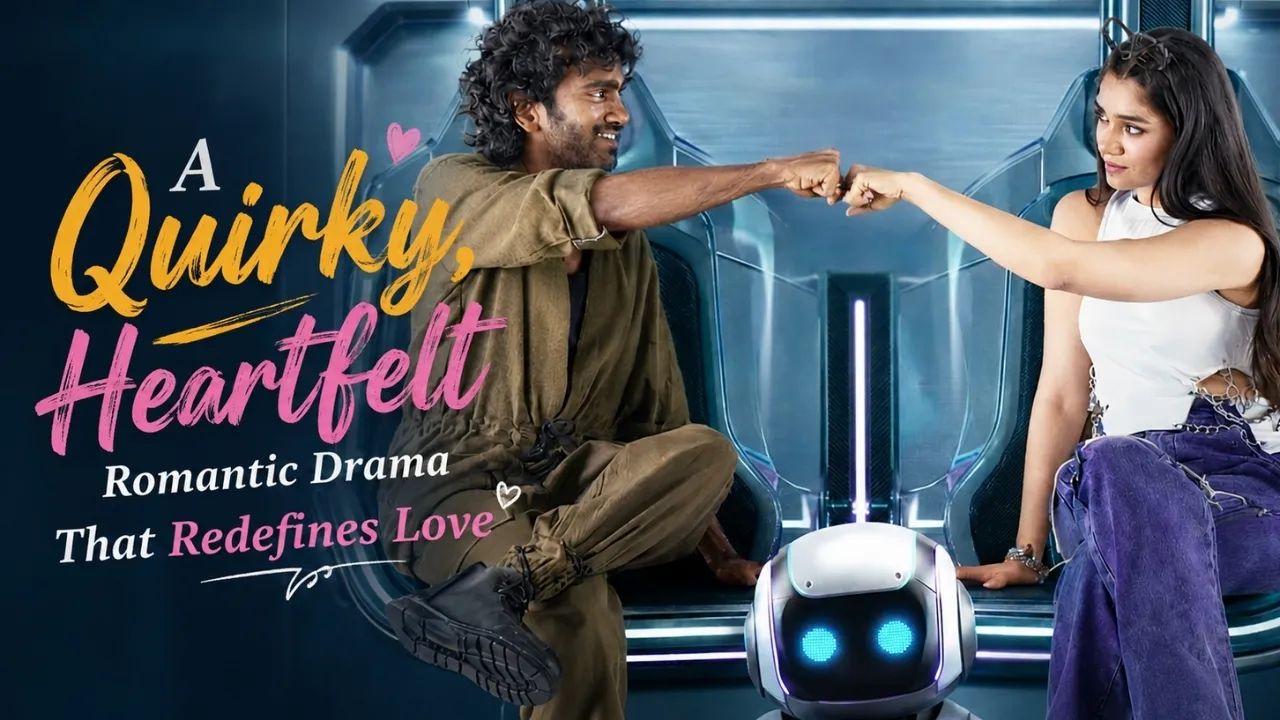
Beneath its colourful sci-fi setting, LIK builds its drama around a simple emotional conflict: can genuine relationships survive in a world where technology promises perfect compatibility? Rather than relying on traditional romantic misunderstandings, the film explores how people begin to trust algorithms more than their own instincts.
The concept is engaging because it reflects a real-world trend. Dating apps and recommendation systems already influence how people meet and interact, making the film’s futuristic premise feel believable. While the screenplay occasionally drifts into commercial comedy, the central conflict remains the story’s strongest and most thought-provoking element.
A Future Chennai That Feels Bright, Busy and Slightly Artificial — in Good and Bad Ways
One of the most noticeable things about LIK is the way it imagines its world. This is not a dark dystopian sci-fi film. It’s glossy, colourful, playful, and designed to feel youthful rather than bleak. The future here is full of digital convenience, stylised environments, and visual polish. It’s a world that looks attractive on the surface, which makes sense because the film wants us to understand why people would willingly surrender their choices to it.
That production design matters. The futuristic setting isn’t just decorative; it supports the film’s central idea. The more seamless and seductive this world feels, the easier it is to believe that people have stopped questioning how much control they’ve handed over. The city, the technology, and the overall visual language all contribute to the sense that this is a society where personal life has become system-managed.
At the same time, the film’s glossy aesthetic can also work against it. Because everything is so bright, busy, and stylised, the emotional side of the story sometimes feels less grounded than it should. The future setting is convincing enough as a concept, but it occasionally creates distance between the audience and the romance. Instead of feeling like two people navigating a believable emotional crisis, some scenes feel like attractive ideas moving through an attractive world.
Still, as an experiment in mainstream Tamil sci-fi rom-com world-building, the film deserves credit. It may not be flawless, but it definitely has personality.
Pradeep Ranganathan Gives the Film Its Youthful Pulse
Pradeep Ranganathan is a big part of why LIK remains watchable even when the script starts wobbling. He brings a familiar youthful energy to the film — the kind of screen presence that feels casual, expressive, and tuned into the rhythm of modern commercial Tamil cinema. He doesn’t play the character with heavy dramatic intensity, and that works in the film’s favour because LIK needs someone who can move between comedy, romance, confusion, and emotional sincerity without making the tone collapse.
What helps Pradeep here is that his performance never tries too hard to make the futuristic premise feel heavy. He keeps the role accessible. Even when the world around him becomes concept-driven, he behaves like a recognisable young man reacting to increasingly strange circumstances. That balance matters. Without it, the film could have become too self-conscious or too gimmicky.
There are limitations too. The character itself isn’t written with enough emotional complexity to fully challenge him. In several scenes, the performance depends more on charm and energy than on deep internal conflict. But within the film’s chosen tone, Pradeep does what he needs to do: he keeps the narrative moving and gives the romance a relatable face.
Krithi Shetty Brings Warmth, While S. J. Suryah Brings the Spark the Film Sometimes Lacks
Krithi Shetty fits naturally into the film’s breezy romantic space. She has a softness and screen ease that helps the emotional side of the story, especially in a film that can otherwise feel overly designed. Her character benefits from being positioned inside the film’s central debate about love and technology, and Krithi plays that role with enough charm to keep the relationship watchable even when the writing becomes thin.
But the performance that adds the most flavour to the film is S. J. Suryah. He brings unpredictability, confidence, and a sense of dramatic fun that the movie badly needs in its weaker stretches. There’s an edge to his presence that helps break the film out of its softer, more generic romantic mode. In a story built around technology, control, and emotional manipulation, his energy feels right at home.
Several viewers have pointed out that scenes involving S. J. Suryah are among the film’s livelier stretches, and that feels accurate. He gives the film a pulse whenever it starts settling into routine.
The supporting cast, including Yogi Babu, also helps maintain the film’s easygoing commercial rhythm. Not every joke lands, but the ensemble keeps the world feeling active rather than empty.
The Romance Is Pleasant, But It Rarely Becomes Emotionally Strong Enough
This is where LIK becomes a little frustrating. For a film built around such a strong concept, the actual love story at the centre of it feels lighter than it should. It’s not that the romance is bad; it’s just that it doesn’t dig deep enough to fully justify the emotional stakes the film wants us to feel.
The chemistry between the leads works in parts. There are moments of charm, some playful interactions, and enough sweetness to make the relationship easy to watch. But the emotional progression often feels more functional than deeply felt. The film tells us that this relationship matters in a world controlled by systems, yet it doesn’t always give the romance enough quiet, vulnerable, human scenes to make that idea hit harder.
That’s why the concept keeps overshadowing the love story. You stay interested in what the film is trying to say about technology and choice, but the romance itself doesn’t always rise to the same level of fascination.
In a simpler rom-com, that might not be a major issue. But in LIK, where the entire premise depends on the emotional significance of one relationship resisting a system, it matters more.

Where the Film Wins: Ambition, Style and the Willingness to Try Something Different
Even if LIK doesn’t fully deliver on everything it promises, it still deserves credit for not playing safe.
It has a genuinely interesting premise
Tamil commercial cinema doesn’t often attempt romantic comedies built around algorithm-driven compatibility, future tech, and emotional autonomy. That alone makes LIK more interesting than many safer genre films.
It creates a world instead of just a gimmick
The futuristic setting isn’t a lazy backdrop. The film clearly invests in visual identity, digital culture, and the atmosphere of a society shaped by technology.
It stays energetic
Even in its weaker sections, the film rarely feels lifeless. It has colour, movement, music, and enough performance energy to remain watchable.
Where It Falls Short: Too Much Noise Around a Strong Core Idea
The biggest weakness of LIK is that it doesn’t fully trust its own best material.
Instead of sharpening the emotional conflict between human feeling and algorithmic control, the screenplay often gets distracted by side humour, tonal excess, and scenes that feel written for immediate commercial effect rather than long-term emotional payoff. Some viewers enjoyed the first half’s playful, lighthearted mood but felt the second half dragged or became repetitive.
There’s also a larger tonal issue. The film wants to be a sci-fi rom-com, a satire of digital culture, a star-driven entertainer, and a heartfelt love story all at once. That’s a lot to balance. Sometimes it manages it. Other times it feels like several different movies sharing the same set of ideas.
The result is a film that is often fun in the moment but less satisfying when you step back and look at the whole thing.
So What Is LIK Really — A Romance, a Satire, or a Warning About the Future?
Maybe the most interesting thing about LIK is that it never completely settles into one identity.
It isn’t a pure romance because the emotional story isn’t intimate enough for that.
It isn’t a full satire because it doesn’t push its social commentary sharply enough.
It isn’t hard sci-fi because the film uses the future more as a playful framework than a deeply explored system.
And it isn’t just a light entertainer either, because it clearly wants to say something about how people surrender their emotional lives to technology.
In a strange way, that identity crisis is both the film’s weakness and its charm. LIK feels messy because it’s trying to do too much, but it also feels alive for the same reason. You can see the ambition in every part of it. The film may not have complete control over its own tone, but it definitely has a point of view.
While watching LIK, the most noticeable aspect wasn’t its futuristic setting but how confidently it tries to blend romance, comedy, and science fiction into a mainstream entertainer. Some emotional moments landed better than others, yet the film consistently remained engaging because of its lively performances and colourful presentation.
Final Verdict
LIK: Love Insurance Kompany is one of those films that is easier to appreciate than to fully love. It has a fresh concept, a playful futuristic setting, and a cast that keeps things moving with enough energy to make the ride enjoyable. Vignesh Shivan clearly wants to do more than make a routine romantic comedy, and that ambition gives the film its personality. Its biggest strength lies in presenting a fresh romantic premise with confidence. Even when the screenplay becomes uneven, the film remains engaging because of its energetic performances, imaginative world-building, and willingness to experiment with familiar genre conventions.
At the same time, the film doesn’t completely convert that idea into a deeply satisfying emotional experience. The romance is pleasant rather than powerful, the second half feels less sharp than the setup deserves, and the movie often gets in its own way by overloading itself with tone shifts and commercial distractions. Still, there is enough charm, style, and curiosity in LIK to make it worth a watch — especially if you enjoy Tamil rom-coms that are willing to experiment instead of repeating the same old formula.
Conclusion
LIK: Love Insurance Kompany isn’t a flawless film, but it succeeds by offering something refreshingly different from the usual romantic comedy formula. Its imaginative premise, energetic performances, and vibrant visual style make it an entertaining watch despite a few narrative inconsistencies.
If you enjoy Tamil films that experiment with new ideas rather than relying on predictable storytelling, LIK deserves a place on your watchlist. It may not deliver every emotional moment with equal impact, but its originality and ambition make it a romantic sci-fi drama that’s easy to recommend.
Frequently Asked Questions (FAQs)
Is LIK: Love Insurance Kompany worth watching?
Yes, if you enjoy romantic comedies with a fresh science-fiction twist. The film offers an original premise, energetic performances, and an entertaining blend of romance and humour, even if its emotional impact isn’t always consistent.
Is LIK: Love Insurance Kompany a sci-fi movie?
Partly. While the film uses futuristic technology and an algorithm-driven matchmaking concept, it focuses more on romance and comedy than traditional science-fiction.
Who delivers the best performance in LIK?
Pradeep Ranganathan brings youthful energy to the lead role, Krithi Shetty adds warmth to the romance, and S. J. Suryah stands out with a charismatic and entertaining performance that elevates several scenes.
What are the biggest strengths of LIK?
The film’s strongest aspects are its original concept, colourful futuristic world-building, engaging performances, and willingness to experiment with the traditional Tamil romantic comedy formula.
What are the main weaknesses of LIK?
The romance doesn’t always reach the emotional depth the story promises, and the screenplay occasionally loses focus by trying to balance comedy, science fiction, romance, and commercial entertainment at the same time.