 by
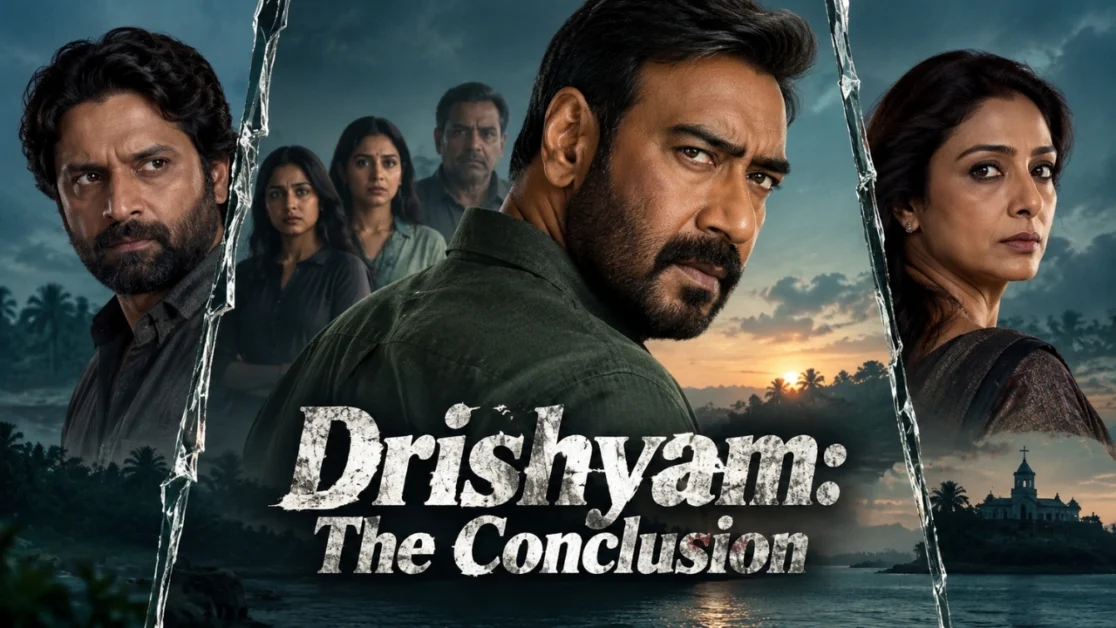
by Drishyam: The Conclusion brings Vijay Salgaonkar back for one final confrontation with the law. Set six months after Drishyam 2, the film introduces Crime Branch officer Rajveer Singh Tomar, who reopens the Sameer Deshmukh case and begins looking at the evidence from a different angle.
Directed by Abhishek Pathak, the film stars Ajay Devgn, Tabu and Jaideep Ahlawat. Unlike the earlier Hindi films, this chapter follows an original Hindi storyline rather than directly adapting the Malayalam continuation. Pathak has also described it as the conclusion of Vijay Salgaonkar’s story.
Quick Answer: What Happens at the End?
Does Vijay get convicted? No. The prosecution fails to build a case strong enough for conviction.
What happens to the skeleton? Vijay arranges a replacement skeleton as part of his plan, allowing him to deal with Savio’s request without exposing himself.
What happened during the missing four hours? Those hours are eventually explained as part of Vijay’s carefully planned move involving the replacement skeleton.
Is Vijay proven innocent? No. The film separates legal victory from moral innocence.
Is Drishyam 4 confirmed? No officially announced Hindi Drishyam 4 is established in the material covered here.
Drishyam: The Conclusion Story
The Salgaonkar family is still living with the consequences of Sameer’s death. Meera Deshmukh has not found closure, while Rajveer Singh Tomar sees an opportunity to reopen the case.
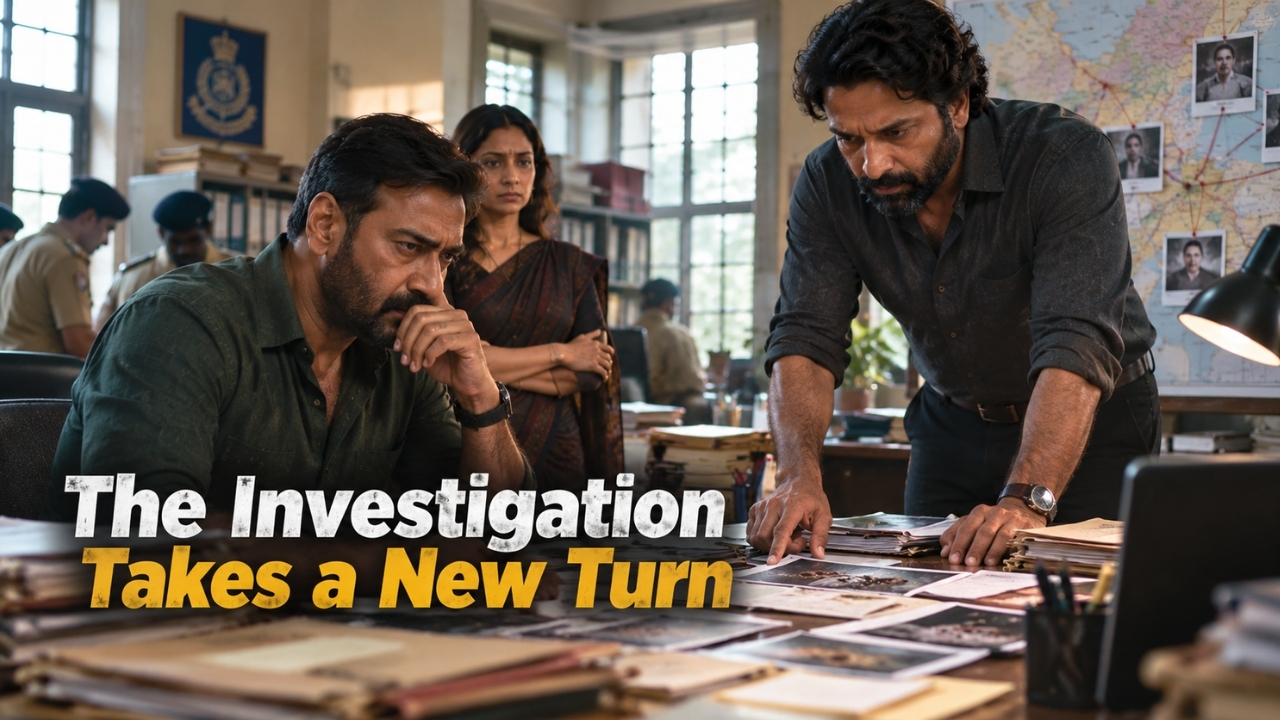
Rajveer does not try to catch Vijay through pressure or a simple confession. He studies the old investigation, the people involved and the physical evidence surrounding the original cover-up.
His real target is the logic behind Vijay’s plan.
That makes Rajveer a more interesting opponent than someone who simply suspects Vijay. He is trying to work backwards from the gaps in the original story and find the point where Vijay’s carefully constructed version stops making sense.
The result is a familiar Drishyam cat-and-mouse setup, but with a different question driving it: can Rajveer turn his reconstruction of events into evidence that will actually hold up in court?
What Does Rajveer Discover?
Rajveer uncovers witnesses and evidence that appear capable of putting Vijay under serious pressure.
The investigation returns to the medical-college evidence and the skeleton connected to the original cover-up. Savio and other people connected to the evidence become important as Rajveer tries to establish what Vijay did and when he did it.
For Rajveer, the challenge is reconstructing the entire sequence rather than finding one dramatic piece of evidence.
His theory may explain what happened, but a theory alone cannot settle the case. The prosecution still needs a reliable chain connecting the major pieces of evidence.
That becomes the turning point of the climax.
What Happened During the Missing Four Hours?
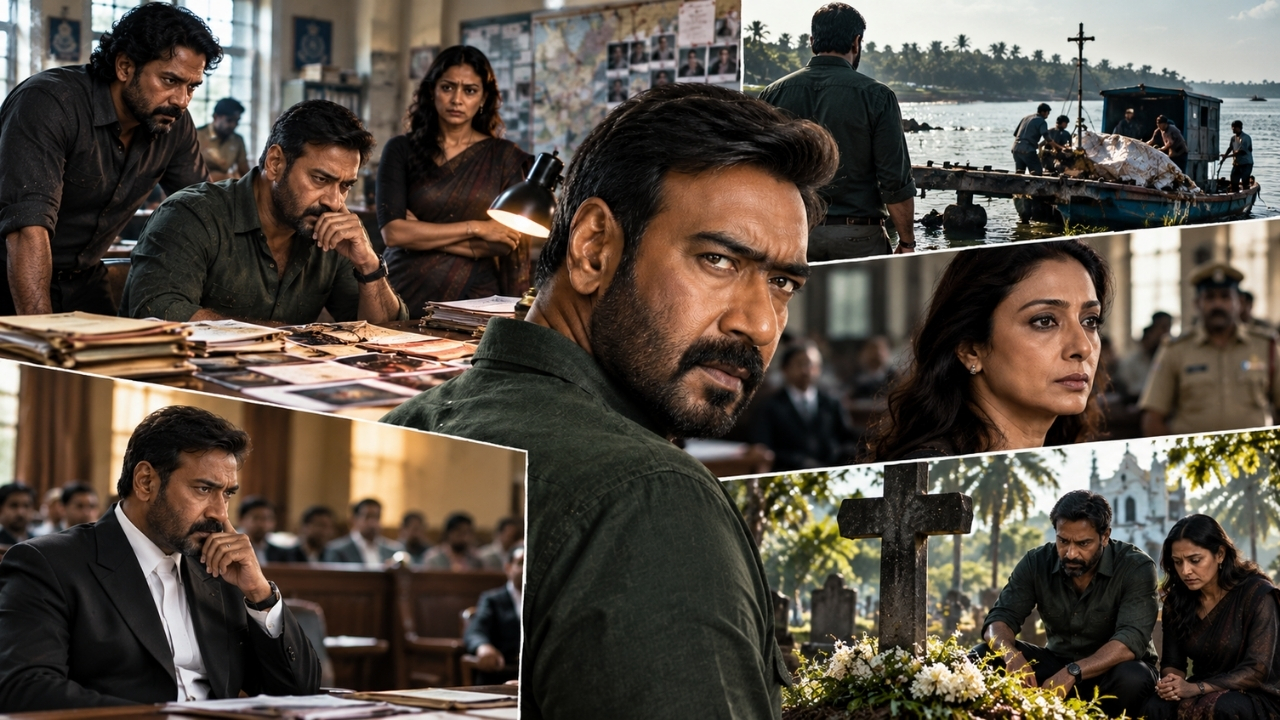
The missing four hours are one of the film’s key mysteries.
Rajveer sees the unexplained gap in Vijay’s movements as an opportunity. If those hours can be properly explained, they could reveal what Vijay was actually doing while the police could not account for him.
The answer connects directly to the skeleton.
Savio wants the skeleton connected to him to be returned so it can eventually receive a proper burial. Vijay cannot simply move the original evidence without creating another problem for himself.
Instead, he arranges for an artificial replacement skeleton to be created.
During the period that Rajveer cannot fully account for, Vijay uses that replacement as part of his plan. The apparent weakness in his timeline therefore becomes another piece of the larger strategy.
Later, Vijay and Nandini visit the church cemetery and learn that Savio has died. The film then fills in the missing period and shows how the replacement skeleton was used.
The twist is clever within Vijay’s established character, although viewers who prefer strict realism may find the number of variables he manages to anticipate somewhat convenient.
What Happens to the Skeleton?
The skeleton is more than a mystery object. It connects the old cover-up to Rajveer’s new investigation.
Vijay’s solution is designed to deal with two problems at once: Savio’s request and the danger that the original evidence could expose him.
The replacement-skeleton idea gives the film its late-stage puzzle element, but it also reveals one of the screenplay’s weaknesses. The more precisely Vijay’s plan works, the more the audience has to accept that he anticipated several things going exactly as expected.
For a Drishyam story, that is part of the appeal. For viewers looking for a completely airtight thriller, it may feel too convenient.
What Happens in Court?
Rajveer and Public Prosecutor Indrajith Shetty take the investigation into court and attempt to connect the witnesses, physical evidence and Vijay’s movements into one coherent case.
The courtroom section works because it stops asking only “What probably happened?” and starts asking “What can actually be established?”
Rajveer may have reconstructed a convincing version of events. The prosecution still has to connect the important evidence without leaving gaps that the defence can exploit.
Vijay does not need to produce a completely different explanation for every event. His legal advantage comes from exposing weaknesses in the prosecution’s version.
That is enough to prevent the case from reaching the required level of certainty.
Does Vijay Get Convicted?
No. Vijay is not convicted.
The prosecution fails to establish a case strong enough to secure a conviction against Vijay and his family.
But the film is careful not to turn that result into proof of Vijay’s innocence.
He wins legally, while the underlying tragedy remains untouched. Sameer is still dead, Meera is still grieving, and Vijay’s escape does not erase the choices that led everyone to this point.
That difference is important because it stops the climax from becoming a simple celebration of Vijay’s cleverness.
What Happens to Meera?
Meera provides the emotional perspective that Vijay’s victory would otherwise lack.
Vijay’s actions are driven by his determination to protect his family. Meera experiences the same events from the opposite side. Her son is dead, and the people she believes responsible have escaped punishment.
Her final line captures that contradiction:
“Wo galat hokar bhi hero hai aur hum sahi hokar bhi villain.”
The line is less about declaring Vijay a hero or villain and more about showing how differently the same outcome can look depending on whose loss you are living with.
Vijay leaves protected by the legal outcome. Meera does not receive the closure she wanted.
That is why the final scene carries more emotional weight than a straightforward victory ending.
Drishyam: The Conclusion Ending Explained
The ending can be understood on two levels.
On the legal level, Vijay survives because the case against him cannot be established strongly enough for conviction.
On the moral level, nothing has been solved for Meera. Vijay’s family is protected, but another family continues to live with the consequences.
That is what gives the conclusion its purpose. The film does not suddenly turn Vijay into an innocent man, nor does it reduce him to a conventional villain.
He remains the same complicated character the franchise has built over the years: a father willing to manipulate evidence, circumstances and people to protect his family.
The final victory is therefore real, but it is not completely clean.
Ajay Devgn as Vijay Salgaonkar
Ajay Devgn’s performance works because Vijay rarely needs to explain himself.
His pauses, controlled reactions and refusal to panic communicate more than a long dialogue scene would. Even when Rajveer gets closer, Vijay does not suddenly become theatrical or visibly frightened.
Devgn also understands that Vijay’s greatest weapon is not intelligence alone. It is his ability to remain composed while everyone else is trying to understand what he already knows.
That restraint suits the character perfectly.
Jaideep Ahlawat as Rajveer Singh Tomar
Jaideep Ahlawat changes the investigative dynamic of the franchise.
Rajveer is not played as an angry officer constantly trying to intimidate Vijay. Ahlawat makes him patient and observant, someone who tests Vijay’s story for inconsistencies rather than simply demanding answers.
That approach makes the Vijay-Rajveer scenes feel like a battle of observation.
Rajveer can get close enough to make Vijay uncomfortable without turning him into an obviously incompetent investigator. That balance is important for the film’s tension.
Tabu as Meera Deshmukh
Tabu’s role is less about solving the case and more about changing the meaning of Vijay’s victory.
Meera represents the consequence that Vijay cannot manipulate away.
The film could have ended immediately after the courtroom result and treated Vijay’s escape as the final triumph. Meera’s perspective prevents that interpretation from feeling complete.
Her character reminds us that a legal outcome cannot automatically repair personal loss.
What Works in Drishyam: The Conclusion
The Vijay-Rajveer conflict
Rajveer does not simply repeat the investigative approach from the earlier films. He studies the logic behind Vijay’s previous cover-up and looks for the point where that logic might fail.
That gives the third chapter a reason to exist beyond repeating the same mystery.
The final twist
The missing-four-hour reveal and replacement skeleton provide the puzzle element Drishyam audiences expect. More importantly, the film connects the twist to Vijay’s character rather than using it only as a surprise.
The performances
Devgn keeps Vijay controlled and unreadable, while Ahlawat gives Rajveer enough patience and intelligence to feel like a genuine threat.

The emotional ending
Meera’s final perspective adds something the investigation alone cannot provide. Vijay may escape legally, but the emotional damage remains.
What Doesn’t Work
The biggest weakness is the convenience of some of Vijay’s solutions.
The replacement-skeleton plot is inventive, but it requires Vijay to anticipate several developments and execute them with very little room for error. Viewers willing to accept the heightened logic of the franchise may enjoy that precision; others may find it engineered mainly to reach the desired twist.
The film also spends more time solving the puzzle than exploring the emotional consequences of Vijay’s choices. Meera’s perspective helps correct that imbalance, but the screenplay could have given those consequences more room.
Is Drishyam 4 Confirmed?
No.
As of October 2026, there is no officially announced Hindi Drishyam 4 in the material covered here. Director Abhishek Pathak has described Drishyam: The Conclusion as the ending of Vijay Salgaonkar’s story.
So reports or fan theories about another sequel should not be treated as confirmation unless the filmmakers officially announce one.
Final Verdict
Drishyam: The Conclusion succeeds because it gives Vijay and Rajveer different ways of looking at the same case. Rajveer is trying to reconstruct the past; Vijay is trying to make sure that reconstruction never becomes enough to destroy his family.
The screenplay is not completely airtight, particularly when some of Vijay’s solutions become almost too perfectly arranged. But the central conflict remains engaging, the performances give the final chapter enough weight, and Meera’s perspective keeps the ending from becoming a simple victory lap.
As a conclusion to Vijay Salgaonkar’s Hindi story, the film gives him the ending the character has always been moving toward: he protects his family, survives the case and walks away — but the moral consequences stay behind.
Final Verdict: A twist-driven and emotionally complicated finale that gives Vijay a legal victory without pretending that every consequence has disappeared.
FAQs
Why does Rajveer fail to convict Vijay?
Rajveer develops a convincing reconstruction, but the prosecution cannot connect every major piece of evidence into a complete case strong enough for conviction.
What was Vijay doing during the missing four hours?
He was carrying out the plan involving the replacement skeleton, fulfilling Savio’s request while protecting himself from the investigation.
Why is the skeleton important?
It links the original cover-up to Rajveer’s investigation and becomes central to Vijay’s strategy for controlling the evidence.
Is Vijay actually innocent?
No. The film does not establish Vijay’s innocence. His victory comes from the failure to prove the case against him, not from proving that nothing happened.
What does Meera’s final line mean?
It highlights the moral contradiction of the ending: Vijay can be seen as a protector by his family while appearing responsible for another family’s suffering.
Is Drishyam 4 officially confirmed?
No. There is no officially announced Hindi Drishyam 4 in the information covered here, while The Conclusion has been presented as the final chapter of Vijay Salgaonkar’s story.