
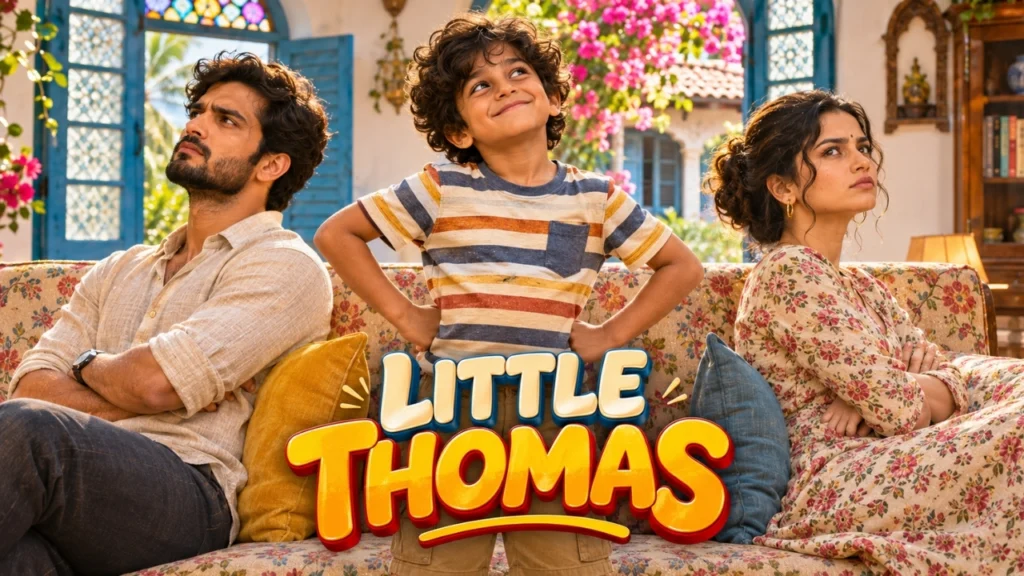
A seven-year-old boy believes that getting a baby brother will make his family happy. His parents, however, are struggling with money, work and a marriage that is slowly losing its warmth. This unusual difference between a child’s imagination and adult reality forms the foundation of Little Thomas, a Hindi comedy-drama written and directed by Kaushal Oza.
Starring Hridansh Parekh, Gulshan Devaiah and Rasika Dugal, the film is set in 1990s Goa. It follows Thomas Miranda, an only child who becomes curious about where babies come from. When he learns that kissing is connected to having a baby, he decides to bring his quarrelling parents closer so that his wish can come true.
Released in Indian cinemas on October 23, 2026, Little Thomas is a family film with a nostalgic setting and a subject that moves between childhood humour and marital tension. Its most appealing idea is also its biggest storytelling challenge: how can a child’s innocent mission carry a film that is equally concerned with the complicated lives of adults?
A Child’s Question Becomes the Family’s Unusual Problem
Thomas does not want a new toy or an expensive birthday gift. He wants a younger brother. His curiosity about childbirth gradually becomes a mission, especially after he connects the idea of having a baby with his parents kissing.
There is one problem: Desmond and Jessie are constantly arguing. Their relationship has become strained by financial pressure and professional uncertainty. Thomas cannot understand why they are unhappy with each other, so he looks for a solution using the limited information available to him.
His investigation takes him beyond his parents. He asks questions, talks to people around him and discusses his theories with friends Nigel and Murthy. The children’s conversations move into subjects such as reproduction, evolution and gravity, showing how easily young minds connect unrelated pieces of information while trying to understand the world.
The premise gives the film a natural source of comedy. Thomas’s logic makes sense to him, even when the adults around him struggle to respond to his questions.
The Comedy Works Best When Adults Run Out of Answers
One example highlighted in India Today’s review is Desmond’s explanation that Thomas came from Malaysia because his T-shirt carries a ‘Made in Malaysia’ label. It is a small moment, but it captures the awkward position parents sometimes find themselves in when children ask questions they are not ready to answer.
The humour comes from the situation rather than a conventional punchline. Desmond is not trying to give a serious scientific explanation; he is attempting to escape an uncomfortable conversation.
This kind of writing suits the film’s child-centred perspective. It allows Thomas’s curiosity to drive the story without turning him into a miniature adult.
Desmond and Jessie: The Marriage Behind the Comedy
The more complicated story belongs to Thomas’s parents. Desmond, played by Gulshan Devaiah, runs a bakery, while Jessie, played by Rasika Dugal, teaches piano. Both are dealing with changes that threaten their professional stability.
Desmond is attached to an old family cake recipe that he continues to use even when selling his products becomes difficult. Jessie, meanwhile, finds that children are increasingly interested in video games rather than piano lessons.
Their disagreements are therefore rooted in practical concerns. Desmond wants to hold on to his methods, while Jessie is more aware of the need to adjust to changing circumstances.
Why the Bakery Is an Important Detail
Desmond’s 75-year-old cake recipe is more than a quirky character detail. It explains his attachment to the past and his difficulty accepting that business conditions have changed.
In the review published by Cinema Express, the bakery is discussed through Desmond’s stubbornness and his refusal to abandon his old methods. The review also mentions his decision to charge customers for cooling, something he considers a matter of honesty rather than an unreasonable business practice.
This makes Desmond an interesting character because his intentions are not necessarily wrong, but his approach can create problems. His idealism is understandable, yet it does not automatically make him a successful businessman.
Jessie Has Her Own Professional Struggle
Jessie’s piano teaching gives the family conflict another dimension. Her work is affected by changing interests among children, which is especially relevant in a story set around 1994.
Rasika Dugal’s character is not simply a mother reacting to Thomas’s questions. She is also a woman dealing with her own professional uncertainty and a relationship that requires attention.
In her interview with Cinema Express, Dugal explained that she trained in piano for four months for the role. She also worked with a dialect coach to develop Jessie’s Goan accent. That preparation gives useful context to the effort behind the character.
Hridansh Parekh, Gulshan Devaiah and Rasika Dugal: The Performances
Hridansh Parekh carries the title role. Thomas needs to be curious, determined and occasionally mischievous, but the character’s innocence must remain believable. His questions are the engine of the story, and the film depends on the audience finding his mission engaging rather than irritating.
Both The Times of India and India Today praise Parekh’s performance. India Today particularly highlights his natural charm and ability to make Thomas’s curiosity feel genuine.
Gulshan Devaiah plays Desmond with an idealistic streak. In a Cinema Express interview, Devaiah described Desmond as an older version of Thomas in terms of his innocent outlook and naivety. That observation offers a useful way to understand the father-son relationship: both characters hold on to their beliefs, even when reality challenges them.
Rasika Dugal brings a more restrained quality to Jessie. Her character is caught between keeping the household running and dealing with a marriage that is under strain. The preparation she undertook for the piano scenes also shows that the role required more than simply playing a worried parent.
The supporting cast includes Hridyannsh Gokani as Nigel, Ninad Pandith as Murthy and Mahabanoo Mody-Kotwal as Mrs Braganza. Other performers include Aarush Sarda, Aseem Hattangady, Preeti Sharma, Faezeh Jalali, Sanjay Gurbaxani and Uday Chandra. The spelling of some supporting character names differs across listings, so the cast information here follows the published credits from BookMyShow and Film Information.
The 1990s Goa Setting Is Part of the Story
The film takes place in Fontainhas, a historic neighbourhood in Goa known for its colourful houses and Portuguese-influenced architecture. The period setting gives Thomas’s curiosity a different context from what it would have in a modern story.
Director Kaushal Oza has explained that the 1990s setting was important because children today can search online for answers to questions about childbirth. In Thomas’s world, information comes through conversations, guesses and interactions with people in the neighbourhood.
That choice is not simply nostalgic decoration. It affects how the central plot works. Thomas has to ask people and interpret their answers instead of immediately finding an explanation on a screen.
The setting also gives the story a community around the family. Neighbours, friends and familiar local spaces become part of Thomas’s investigation.
However, the sense of place has not convinced every critic. Scroll.in appreciated the film’s child-centred humour but questioned whether some speech patterns and mannerisms consistently felt rooted in Goa. This is a useful distinction: a film can recreate the look of a location while still facing challenges in capturing its everyday cultural details.
Three Scenes and Details That Reveal the Film’s Approach
Rather than relying only on general descriptions of childhood innocence, a few specific moments help explain what the film is attempting.
The Malaysia T-shirt Explanation
Desmond’s claim that Thomas came from Malaysia because of his T-shirt label is a clear example of the film’s humour. It shows how an adult can invent an answer when a child asks something difficult.
The Cake Figurine Moment
India Today’s review discusses a sequence in which Desmond attempts to place a couple figurine on top of a multi-tiered cake. The cake collapses, and he realises that the figurine is too heavy.
The moment works as a visual joke, but the review also uses it to describe the screenplay’s problem: the film’s charming ideas sometimes carry more weight than the narrative can support.
The Post-Wedding Dance
Cinema Express highlights a post-wedding function sequence in which Desmond and Jessie dance for their child and briefly reconnect with the affection of their earlier relationship.
This moment is important because it brings the parents’ emotional story into focus. Thomas wants his parents to become close again, and the dance offers a glimpse of the connection that still exists beneath their disagreements.
These are examples reported and discussed by critics, not claims of personal viewing experience.

Where the Screenplay Loses Momentum
The film’s central idea is strong enough to sustain a short comedy, but a feature-length story needs development beyond the repeated question of where babies come from.
This is where the reviews identify a common weakness. India Today argues that the film repeatedly returns to Thomas’s cuteness instead of developing the emotional consequences of his parents’ strained relationship. Scroll.in similarly observes that the narrative circles back on itself and takes longer than its premise requires.
Cinema Express is more positive about the second half, suggesting that the film becomes more effective when it gives greater attention to Desmond and Jessie’s marriage. The contrast between these assessments shows that the film’s emotional material is not without value; the issue is how consistently the screenplay develops it.
For a family drama, this matters. Thomas’s wish creates the initial hook, but the parents’ relationship is what gives the story its emotional stakes.
Critical Reception: What the Reviews Actually Say
The film has received a mixed response from critics:
-
The Times of India: 3/5. Its review appreciates the performances, nostalgic atmosphere and gentle treatment of childhood. Read the review.
-
India Today: 2.5/5. It praises Hridansh Parekh and the lead performances but finds the screenplay emotionally underdeveloped. Read the review.
-
Cinema Express: Its review describes the film as a bittersweet glimpse of childhood and adulthood, while noting patchy sections and an unhurried rhythm. Read the review.
-
Film Information: Its review considers the story interesting but thin and repetitive after a point, while appreciating the natural performances. Read the review.
The common ground is that the cast and premise have received appreciation, while the screenplay’s limited development has attracted criticism.
MovieMania Assessment: Who Is This Film For?
Little Thomas is best suited to viewers interested in gentle family dramas, childhood curiosity and stories set in a recognisable community. It offers a different kind of central character from the usual Hindi commercial entertainer: a boy whose biggest problem is something the adults around him barely have the time to discuss.
Its strongest material comes from the contrast between Thomas’s imagination and his parents’ responsibilities. The 1990s setting and the performances add to that appeal.
Its limitation is the screenplay’s tendency to revisit the same comic idea without always deepening the family conflict. Viewers looking for a tightly paced drama may find the film longer than its premise suggests.
MovieMania editorial position: This article is an independently researched film analysis, not a first-hand screening review. We are not assigning a personal star rating without a verified viewing by the reviewer.
Release and OTT Status
Little Thomas was released in Indian theatres on October 23, 2026. BookMyShow lists its runtime as 2 hours and 7 minutes and its certification as UA 7+.
As of November 2, 2026, no confirmed Indian OTT platform or streaming date was available in the listings checked. JustWatch India showed no online streaming offer when checked on October 29, while Filmibeat’s OTT page listed the platform and date as unavailable. These details can change, so readers should check again before making a viewing plan.
Final Verdict
Little Thomas starts with an amusing childhood wish but finds its more meaningful story in the relationship between Desmond and Jessie. Thomas believes that a baby brother can bring happiness back to his home. His parents, however, are facing financial and emotional problems that require a more complicated solution.
Hridansh Parekh gives the film an appealing centre, while Gulshan Devaiah and Rasika Dugal make the parents’ situation believable. The 1990s Goa setting gives the story a distinct identity, and the film’s strongest moments come when its humour and family drama meet.
The screenplay does not maintain that balance throughout, which explains the mixed critical response. Nevertheless, the film offers a recognisable family situation through an unusual child’s perspective.